
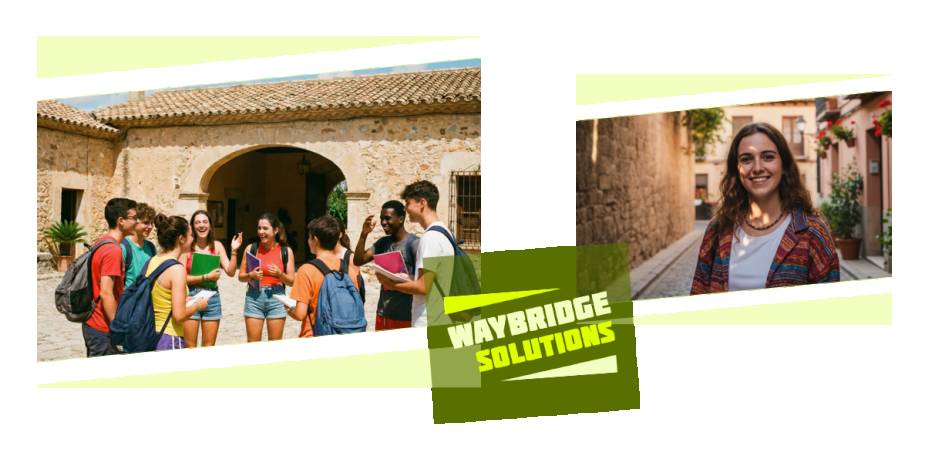
Spain has long been seen as a destination for sun-seekers and language learners. Today, the picture is broader: in the 2024/25 academic year, more than 220,000 international students were enrolled at Spanish universities, and the economic impact of their presence is estimated at €8.3 billion — 0.55% of the country's GDP. Behind these figures is a system that combines affordable tuition, strong programmes in specific fields, and clear rules for those planning to stay.
Find out more about our programmes here
|
||
|
|
|
|
 |
What Spanish Education OffersThe main draw is value for money. At public universities, a bachelor's degree costs from €700 to €1,700 per year, a master's — from €1,000 to €3,500. For comparison: at private institutions, prices reach €20,000, but even there, some programmes pay for themselves through career prospects. The cost of living also remains moderate: in Madrid and Barcelona, a student's budget is around €1,000–1,200 per month; in Granada or Salamanca — around €700–900. |
A second strength is the language. Spanish is the second most widely spoken language in the world after Chinese, and a degree earned in Spain gives access to Latin American markets, where economies are growing faster than European ones. For those studying in English, this is an added bonus: the language is still acquired in everyday life, and after graduation it becomes a working tool.
A third factor is the research base. Spanish universities participate in Erasmus+ programmes and European grants, and fields such as biomedicine, renewable energy, and data science receive funding through national and regional funds. Master's and doctoral students often work on projects with industrial partners, gaining access to real data and equipment.
 |
What Fields Students ChooseDemand among international students in Spain is uneven. Business and management remain the most popular: programmes in administration, marketing, and finance attract students from Latin America, Europe, and Asia. Spanish business schools such as IE, IESE, and ESADE are widely known, and their graduates work at international companies. |
Architecture and design are the second most popular area. Spain is known for its architectural school, and programmes in Madrid, Barcelona, and Valencia combine historical heritage with modern approaches. Students work on real projects, often in collaboration with city administrations.
The third group is engineering and technology. Programmes in computer science, telecommunications, and industrial engineering are growing faster than others, especially at universities in Madrid, Barcelona, and Bilbao. Biotechnology and pharmaceuticals stand out separately: Spain is among the top five European countries by volume of pharmaceutical production, and graduates of these programmes are in demand in the industry.
Humanities and social sciences are less prominent but still present. Spanish philology, art history, and tourism attract students who plan to work in culture or hospitality. Tourism, by the way, remains one of the strongest programmes: Spain is the second most visited country in the world, and universities train specialists for the hotel and tourism business.
 |
What Is Different HereThe Spanish higher education system follows the Bologna Process but retains national characteristics. A first feature is the role of regions. Each autonomous community sets its own tuition prices, and the difference between Madrid and Andalusia can be twofold. For international students, this means that choosing a university is also choosing a budget. |
A second feature is double degrees. Many Spanish universities offer programmes where students earn a degree simultaneously in Spain and at a partner institution in another country. This is especially common in business education and engineering. For international students, this format provides two diplomas and experience of studying in two systems in less time than sequential study would require.
A third nuance is that practical experience is built into the curriculum. Internships (prácticas) can be part of the programme and paid by the employer. Universities have agreements with companies, and students often do internships in their final year, which eases the transition to work after graduation.
 |
Visa RequirementsTo study in Spain, citizens of non-EU/EEA countries require a type D student visa if the programme lasts more than 90 days. For short courses up to 90 days, a tourist visa is sufficient, but you cannot work on it. |
The key requirement is proof of financial capacity. For 2026, the minimum amount is around €600 per month, corresponding to the official IPREM indicator. For a 12-month programme, you need to confirm the availability of approximately €7,200. The money must be in the student's or sponsor's account, and its origin is verified.
In addition to financial proof, you will need a passport valid for at least one year, an admission letter from the institution, medical insurance valid from the first day of study, and a police clearance certificate with an apostille. The application is submitted in advance, taking into account consulate processing times.
After arrival, the student receives a TIE card (Tarjeta de Identidad de Extranjero), which confirms the right to stay and work within permitted limits.
 |
Student Life in SpainThe language barrier is easier to overcome here than in some European countries, but not automatically. Even with a fully English-taught programme, outside campus Spanish becomes necessary: in shops, banks, and city services. The level of English among the local population is lower than in Northern Europe, so trying to handle everyday tasks without Spanish often gets you nowhere. Most international students start learning the language from the first weeks — through university courses or language schools. |
Work during studies has been permitted since 2025 under new conditions. University students and those in vocational training programmes can work up to 30 hours per week during term time. During official holidays, the restriction is lifted, and you can work full-time. For language courses and short programmes, a separate work permit is required and must be arranged through the employer. The minimum hourly wage in 2026 is around €8–9.55 depending on the type of employment, and working 20 hours a week brings in approximately €650–750 per month, covering a significant portion of housing costs.
The cost of living varies by region. Madrid and Barcelona are the most expensive: room rent costs from €500 to €700, and the full monthly budget can reach €1,200–1,400. In Valencia, Seville, or Granada, expenses are 20–30% lower. The main expense is housing, and this is the most difficult part for an international student.
 |
Where Students LiveStudent residences offer a room with or without meals. Prices range from €425 to €1,000 per month, depending on the city and type of accommodation. In public residences, a room may cost around €400–500; in private ones — from €600 to €1,000. The advantage is organised daily life and a social environment; the downside is limited places and the need to book in advance. |
Shared apartment rent is the most common format among upper-year students. A room in a flat with flatmates costs from €300 to €600 in the provinces and from €500 to €800 in Madrid or Barcelona. Search is done through Idealista, Fotocasa, or specialised groups. For an international student without a Spanish guarantor, getting a contract can be difficult: many landlords require a guarantor — a Spanish tax resident. An alternative is rental insurance or paying several months in advance.
Your own studio is the most expensive option. In Madrid, studio rent starts at €900; in Barcelona — from €1,000; in provincial cities — from €500–600. For students who value privacy, this is a justified choice, but financially it is not accessible to everyone.
Studying in Spain means being ready for bureaucracy: visa processing, registration at the place of residence, obtaining the TIE card — all of this takes time and requires attention to detail. For those prepared to take these steps, the country offers affordable education, strong programmes in business, architecture, and technology, and a clear path to work in Europe and Latin America.
Copyright © 2026 Waybridge Solutions