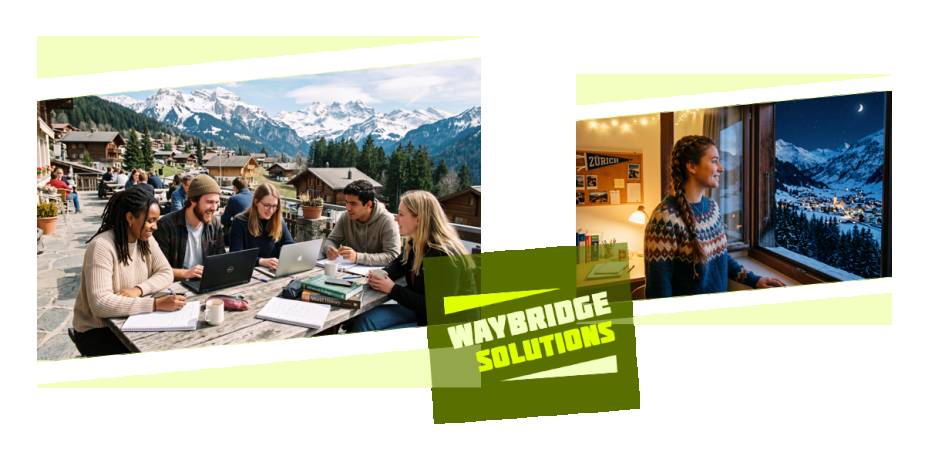
The Swiss education system is unlike anywhere else in Europe when it comes to decentralisation. There is no federal ministry of education here: each of the 26 cantons independently determines the structure of schools and universities, curricula, and even the language of instruction. In 17 cantons, instruction is in German; in four — in French; in one — in Italian. Three cantons are officially bilingual, and Graubünden is trilingual. For international students, choosing a university means choosing a language, a culture, and a set of local admission rules — all at once. These can vary more than in neighbouring countries.
Find out more about our programmes here
|
||
|
|
|
|
 |
What Attracts Students to the Swiss SystemDespite its reputation as one of the most expensive destinations, public university tuition is still moderate. At cantonal institutions, the semester fee ranges from 435 to 2,550 Swiss francs, depending on the canton and the student's status. The federal polytechnic schools — ETH Zurich and EPFL — are more expensive for international students: after the 2025 reform, a semester costs 2,190 Swiss francs, or about 4,380 francs per year. This is significantly less than at private universities in the US or the UK, with a comparable level of research work. |
ETH Zurich ranks 8th in the world in the QS 2027 ranking — the best result among universities in continental Europe. EPFL is in 22nd place. Both schools are connected to national research programmes and industrial consortia, and master's and doctoral students participate in projects funded by the state or companies.
Hospitality management schools are a category of their own. Switzerland has historically remained a centre for training specialists for the hotel industry. Programmes at EHL, Glion, Les Roches, and SHMS combine academic courses with paid internships in hotels, giving students work experience and partially covering the cost of education.
 |
What Fields Students ChooseDemand among international students in Switzerland is distinct. Engineering and natural sciences come first: ETH Zurich and EPFL attract students in computer science, data science, mechanical engineering, electrical engineering, and physics. English-taught programmes are concentrated at master's level, while bachelor's programmes are more often taught in German or French. |
Hospitality management is the second most popular field. Swiss hospitality schools train specialists for international hotel chains, airlines, and the event industry. Graduates of these programmes are in demand in Europe, Asia, and the Middle East.
Economics and finance come third. The University of St. Gallen (HSG) and the University of Zurich offer programmes focused on the banking sector and management. Zurich, as Europe's financial centre, gives students access to internships at banks and consulting companies.
Medicine and pharmaceuticals round out the list. Switzerland is among the leaders in pharmaceutical production, and graduates of medical programmes are in demand in the industry.
 |
What Is Different HereThe main feature of the Swiss system is cantonal autonomy. Cantons and their municipalities finance 90% of public spending on education. This means that admission rules, fees, and even curricula differ depending on the region. For international students, this matters in practice: transferring between cantons may require confirmation of credit equivalence and additional registration. |
A second feature is the dual vocational education system. About 90% of young Swiss people choose vocational training after school, which combines work at an enterprise with classes at a vocational school. This model has few parallels in most of Europe and shapes a labour market where practical skills are valued on par with academic ones.
A third nuance is the absence of entrance exams at most universities. Admission is based on education documents, not tests. For international students, this means that the key question is not passing an exam but confirming the equivalence of their school certificate to the Swiss Matura. A Russian school certificate is usually insufficient for a bachelor's programme: you must either pass the ECUS or study for one or two years at a university in your home country.
 |
Visa RequirementsTo study in Switzerland, citizens of non-EU/EEA countries require a national type D visa. It is issued at the Swiss embassy or consulate in the country of residence before entry. The application is submitted no later than three months before the programme starts. |
The key requirement is proof of financial capacity. Federal recommendations for 2026 set the minimum amount at 21,000 Swiss francs, which must be held in a bank approved by FINMA. For some cantons, the threshold is higher: in Geneva, the amount reaches 30,000 francs; in Zurich, up to 25,000 may be required. The money must be deposited before submitting the visa application.
In addition to financial proof, you will need a passport, an admission letter from an accredited educational institution, medical insurance, and proof of language proficiency. For programmes in German, level B2 or higher is usually required; in French — DELF B2; in English — IELTS from 6.5 or TOEFL iBT from 90.
After arrival, the student registers with the local commune within 14 days and receives a residence permit (usually a B permit), which is valid for the duration of the programme.
 |
Student Life in SwitzerlandThe language question in Switzerland is resolved depending on the region. In German-speaking cantons, the level of English among the local population is high, but in everyday life German becomes necessary. In the French-speaking part of the country, the situation is similar: without French, everyday tasks become difficult. Most international students start learning the language alongside their studies — through university courses or language schools. |
Work during studies is permitted, but with restrictions. Students from the EU/EEA can work up to 15 hours per week during term time and up to 40 hours during holidays. For citizens of non-EU/EEA countries, an additional rule applies: they receive the right to work only six months after the start of their studies. The permit is arranged through the cantonal migration office, and the application is submitted by the employer. Typical student positions are library assistant, waiter, tutor, and campus services staff.
The cost of living in Switzerland is one of the highest in the world. In Zurich and Geneva, a student's monthly budget ranges from 1,800 to 2,500 francs. In Lausanne, Bern, or Basel, expenses are 15–20% lower. The main items are housing, insurance, and food. Lunch in a university canteen costs 7–12 francs; dinner in a restaurant — 20–35. Groceries at Aldi and Lidl are 20–30% cheaper than at Migros and Coop.
 |
Where Students LiveUniversity dormitories are the most affordable option. WOKO manages more than 4,000 rooms in Zurich and the surrounding area, with an average rent of about 754 francs per month. Rooms in ETH Zurich dormitories start at 480 francs; at EPFL — from 500. You should apply immediately after receiving your admission letter: waiting lists fill up fast. |
Shared housing (Wohngemeinschaft) is a common format among upper-year students. A room in a flat with flatmates costs from 600 to 1,100 francs per month, depending on the city. Search is done through WOKO, Studentenwohnungen, or Facebook groups. Competition is high: several people may apply for one room, and landlords often conduct interviews.
Your own studio is the most expensive option. In Zurich, studio rent starts at 1,200 francs; in Geneva — from 1,500; in Lausanne — from 1,000. For an international student without a Swiss credit history and a guarantor, getting a contract is difficult, so many choose a dormitory or shared housing for the first year.
Studying in Switzerland means being ready for bureaucracy and high living costs, but it provides access to world-class research infrastructure and a diploma that is recognised without additional procedures in most countries. For those planning an academic career or work at international companies, this destination remains one of the most balanced in terms of the quality-to-cost ratio of education.
Copyright © 2026 Waybridge Solutions