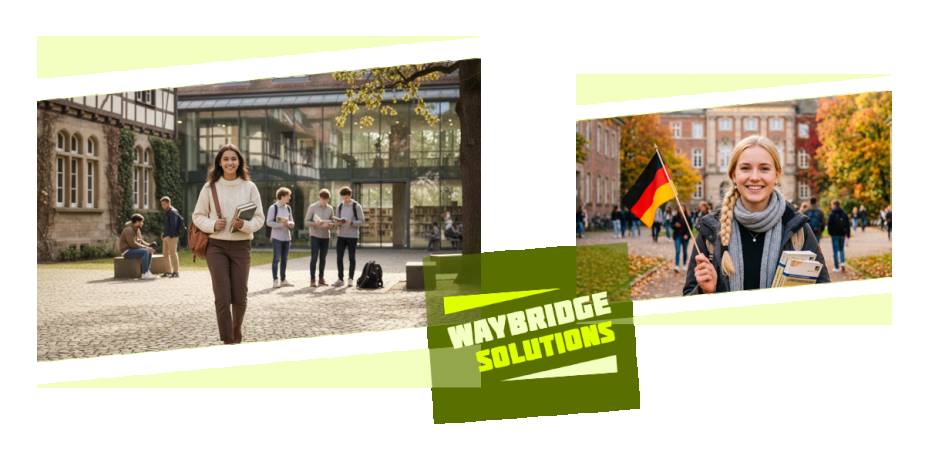
Germany ranks third in the world among the most attractive countries for studying and remains the largest non-English-speaking destination for international students. In the winter semester of 2024/25, around 402,000 international students were enrolled at German universities — 6% more than a year earlier. This trend isn't a passing fashion — it reflects enduring strengths of the system: low tuition costs, a strong research base, and clear pathways to work after graduation.
Find out more about our programmes here
|
||
|
|
|
|
 |
What Attracts International StudentsGermany's main difference from most popular destinations is cost. Public universities here do not charge tuition for most bachelor's and consecutive master's programmes. In 14 of the 16 federal states, education is free; in Bavaria, tuition is charged by the Technical University of Munich, LMU Munich, and some other institutions that have been granted the right to set their own fees. In Baden-Württemberg, students from non-EU countries pay €1,500 per semester. Instead of tuition, students pay a semester contribution, which usually ranges from €194 to €453 depending on the university and covers administrative costs, and often includes a public transport pass. |
A second factor is the growth of English-taught programmes. Today there are around 2,400 fully English-taught programmes in Germany, of which approximately 2,000 are at master's level. This allows students to apply without knowing German, although it will still be needed for everyday life. According to the EF English Proficiency Index 2025, Germany ranks 4th in the world for English proficiency.
A third factor is research infrastructure. German universities are closely connected with the research institutes of the Max Planck Society, the Fraunhofer Society, and industrial laboratories. Master's and doctoral students often participate in projects funded by the state or companies, which gives them access to equipment and data that are not available in classrooms.
 |
What International Students ChooseDemand for programmes in Germany is heavily skewed toward technical fields. In 2024/25, engineering specialisations were chosen by 43% of all international students. In total, STEM fields account for around 57% of all enrolments. This is no accident: Germany remains a country with high demand for engineers, and universities respond with corresponding programmes. |
Among engineering fields, 2026 saw a change in leadership. Electrical engineering overtook mechanical engineering for the first time and became the most popular choice — 28.6% of applications versus 25.1% for the mechanical profile. The reason is the energy transition and the development of the electric vehicle industry, which have created demand for specialists in smart grids, power electronics, and embedded systems. The Technical University of Berlin and the Karlsruhe Institute of Technology already offer fully English-taught master's programmes in these fields.
Mechanical engineering hasn't lost ground — it has simply moved to second place. Universities from the TU9 association — Aachen, Munich Technical, Stuttgart — remain centres for training mechanical engineers and automotive specialists. The third-largest group is industrial design and automation, where the number of applications is around 12% of the total flow.
Humanities and creative fields are less prominent but still present. Music and cultural studies programmes attract international students because state conservatories charge no tuition and teaching standards are high. Economics and management retain steady interest, especially in programmes at the intersection with technology — technical management, industrial economics, and innovation management.
 |
What Distinguishes the German SystemOne feature that's rare elsewhere is decentralisation. Education in Germany is the responsibility of the federal states, not the central government. Each state sets its own admission rules, curricula, and even the structure of school education. For international students, this means that requirements may differ depending on which state the university is located in. There is no single "German standard" for admission. |
A second feature is the "research and teaching" model. Unlike systems where the bachelor's degree is built around lectures and seminars, German universities involve students in research from the early years. Upper-year students and master's students often work in laboratories or participate in projects funded by the German Research Foundation (DFG) or industrial partners. For doctoral students, this means that the dissertation is written not in isolation but within an active research group.
A third nuance is the recognition of qualifications. Germany does not require additional nostrification for most diplomas obtained in countries with a comparable education system. But for admission from countries where the school leaving certificate does not correspond to the German Abitur, a preliminary procedure is required — either through a Studienkolleg or by passing examinations confirming equivalence.
 |
Visa RequirementsTo study in Germany, non-EU citizens need a national category D visa, not a Schengen visa. You must apply for it in advance at the German consulate or embassy in your country of residence. Processing a student visa takes from six to twelve weeks, so it is recommended to submit your application no later than three months before the programme starts. |
The key requirement for the visa is proof of financial capacity. From 2026, the minimum amount is €11,904 per year, or €992 per month. This is confirmed through a blocked account (Sperrkonto), a scholarship from a German organisation, or a guarantee. The blocked account is the most common option: the student deposits the sum into a special account from which they can withdraw the established amount monthly after arriving in Germany.
In addition to financial proof, you will need a valid passport, an admission letter from a German university, medical insurance, and — for some programmes — proof of language proficiency. For programmes in German, level B2 or higher is usually required; for English-taught programmes, IELTS from 6.0 or TOEFL iBT from 80.
After arrival, the student receives a residence permit under §16b AufenthG, which grants the right to study, work within permitted limits, and is extended as the programme continues.
 |
Student Life in GermanyThe first challenge international students face in Germany is the gap between classroom English and everyday German. Even if the programme is entirely in English, outside campus German becomes necessary: at the bank, in the city administration, on public transport, when renting housing. One student at the Technical University of Munich noted that "even when choosing an English-taught programme, everyday situations — from opening an account to registering your address — require German." That's why most international students start learning German alongside their main programme, often through free courses at the university or a Volkshochschule. |
Students are allowed to work from their first semester. Since March 2024, the limit has been increased to 140 full days or 280 half-days per year — approximately 20 hours per week during term time. During holidays, the restriction does not apply, and the student can work full-time. A "mini-job" with income up to €556 per month is not subject to taxes or social contributions, making it a convenient option for part-time work in a café, library, or supermarket. However, finding work without German is difficult: most positions that do not require the language are low-skilled labour with high competition. Knowing German at B1 level or above noticeably expands your options.
After graduation, a student can remain in the country for 18 months on a job-seeker visa. During this time, they can work without restrictions on industry or position. According to surveys, more than 60% of graduates find work in their field within this period, and after two years of continuous employment and with German at B1 level, it becomes possible to apply for permanent residence.
 |
Where Students LiveHousing is the most expensive and most competitive aspect of student life in Germany. There are three main formats. A student dormitory (Studentenwohnheim) is the cheapest option: a room costs from €200 to €450 per month, including utilities and internet. Dormitories are managed by Studentenwerk organisations. The downside is long waiting lists: in Berlin or Munich, waiting for a place can take from six months to two semesters. You should apply immediately after receiving your admission letter, without waiting for the visa. |
A WG (Wohngemeinschaft) is a shared flat where each person has their own room and the kitchen and bathroom are shared. This is the most common format among upper-year students. Costs range from €300 to €450 in Leipzig or Dresden to €700–1,000 in Munich. Search is done through sites like WG-Gesucht.de and often includes an interview with future flatmates. This format gives more freedom in choosing the neighbourhood and flatmates but requires time to search.
Your own studio or apartment is the most expensive option. In large cities, renting a one-room apartment starts at €500–700 in Leipzig and reaches €1,100–1,700 in Munich. For an international student without a credit history or guarantor, getting a rental contract is harder: many landlords request proof of income, and sometimes an interview. In Berlin and Munich, competition for housing is so high that a flat viewing can attract dozens of applicants.
Regardless of the format, after moving in you must register your address at the local registration office (Einwohnermeldeamt) within two weeks. Without this document, you cannot open a bank account, take out insurance, or sign an internet contract. Registration is the first administrative step you should take immediately after moving.
Copyright © 2026 Waybridge Solutions