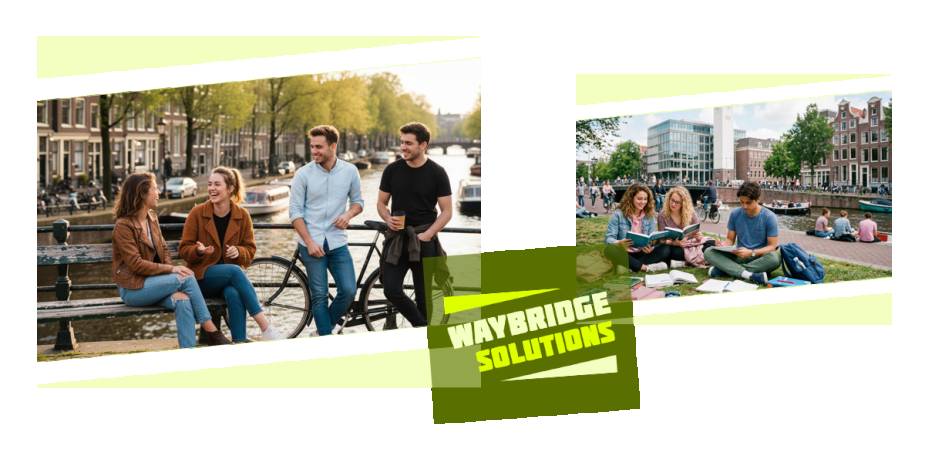
In the 2025/26 academic year, 129,764 international students were enrolled at Dutch universities. For the first time in twenty years, this figure didn't grow — it dipped slightly, by 133 students. This stability isn't just about the reputation of Dutch universities; it's also about how the system itself is structured: a large number of English-taught programmes, a pragmatic approach to learning, and close ties with the labour market. For international students, this means a clear pathway, but it demands attention to detail — from visa requirements to finding housing.
Find out more about our programmes here
|
||
|
|
|
|
 |
What Dutch Education OffersThe Netherlands' main strength is the wide choice of English-taught programmes. There are over 2,100 such programmes in the country, mainly at master's level and at universities of applied sciences. This allows students to apply without knowing Dutch, although the language will be needed for everyday life and especially for work. |
Tuition costs depend on citizenship. For students from the EU, EEA, Switzerland, and Suriname, a state-subsidised rate applies — €2,694 per year. For citizens of other countries, the fee is higher: a bachelor's degree costs from €9,000 to €25,000, a master's — from €12,000 to €35,000 per year, depending on the programme and institution. These amounts do not cover living expenses, but the cost of education itself remains moderate compared to private universities in the US or the UK.
Another strength is the research base. Dutch universities rank in the top global rankings, and fields such as artificial intelligence, sustainable energy, and life sciences receive state funding through NWO and industrial consortia. Master's students often participate in projects with real clients, and doctoral students work under a contract with the university, receiving a salary rather than a scholarship.
 |
What International Students ChooseThe pattern of demand reflects the system's pragmatism. The most popular are programmes in business and management, especially at universities of applied sciences. International business, marketing, finance, and logistics — these fields prepare students for work in companies operating throughout Europe. |
Engineering takes second place by number of applications. Technical universities in Delft, Eindhoven, and Twente offer programmes in mechanical engineering, electrical engineering, robotics, and aerospace engineering. Artificial intelligence and data science stand out in particular: these programmes are growing faster than others, and graduates are in demand in the tech sector.
Social sciences and humanities are less prominent but still present. International relations, European law, psychology, and communications attract students who plan to work in NGOs, international organisations, or media. Creative fields — design, architecture, art — are concentrated in specialised institutions such as Design Academy Eindhoven or Gerrit Rietveld Academie.
 |
What Is Different HereThe Dutch education system is built around Problem-Based Learning (PBL). Instead of lectures where students passively take notes from the teacher, classes are held in small groups of 10–12 people. Students receive a real case, discuss it, formulate questions, and independently seek answers, while the teacher acts as a moderator. This method was first developed at McMaster University (Canada) in the 1960s, and then adapted and refined at Maastricht University in the 1970s. For international students, this means a high degree of involvement: you cannot sit at the back, because every session requires participation. |
A second feature is pragmatism in assessment. Exams are often built around open questions and case analysis, rather than multiple-choice tests. Students are assessed not only on their final grade but also on their activity in the group, the quality of their arguments, and their ability to apply theory in practice.
A third nuance is directness in communication. The Dutch value clarity and do not waste time softening formulations. In an academic setting, this shows up in professors pointing out mistakes directly and expecting the same from students. For some, this becomes an advantage — feedback is clear and fast; for others, it is a source of stress, especially in the first year.
 |
Visa RequirementsTo study in the Netherlands, citizens of non-EU/EEA countries require an MVV visa (Machtiging tot Voorlopig Verblijf) and a residence permit (VVR). Universities often act as sponsors of the application and submit documents to the immigration service IND on behalf of the student. The cost of the procedure is €254. |
The key requirement is proof of financial capacity. From 2026, the minimum amount is €1,130.77 per month. The money must be in the student's or their parents' account, and its origin must be confirmed. In addition, you will need a passport, an admission letter, medical insurance, and proof of language proficiency. For English-taught programmes, IELTS from 6.0 or TOEFL iBT from 80 is usually required.
After arrival, the student receives a residence permit for the duration of their studies. It grants the right to work within permitted limits and access to the healthcare system.
 |
Student Life in the NetherlandsThe language barrier is easier to overcome here than in many European countries. The level of English proficiency among the Dutch is one of the highest in the world: over 90% of the population speaks it at a conversational level or better. At universities and in everyday life in large cities, English is sufficient. However, for work, especially in local companies, Dutch becomes necessary. Many students start learning it alongside their studies — through university courses or apps. |
Work during studies is permitted. A student with a residence permit can work no more than 16 hours per week during term time and full-time in June, July, and August. Work requires a permit from the employer, but for part-time work on campus or in student organisations, no permit is needed. The minimum hourly wage for students over 21 as of 1 July 2026 is €14.99 gross. Working 10 hours a week brings in approximately €560 per month, which covers part of housing and food costs.
The cost of living depends on the city. Amsterdam is the most expensive: room rent starts at €600, and the average monthly student budget is around €1,200–1,400. In Utrecht, Rotterdam, or Groningen, expenses are 15–20% lower. The main expense is housing, and this is the most difficult part.
 |
Where Students LiveThe Netherlands is experiencing an acute shortage of student housing: the deficit is around 20,200 units. Universities warn international students that finding a room may take several months and recommend starting before arrival. There are three main options. |
Student dormitories are managed by organisations such as SSH or Xior. A room in such a complex costs from €425 to €1,200 per month, including utilities. Conditions vary: in some cases, it is a room with a shared kitchen; in others, a separate studio with a bathroom. Universities often reserve places for first-year international students, but the application must be submitted in advance.
Shared housing, or hospiteren, is a common format among upper-year students. A room in a flat with flatmates costs from €400 to €700, depending on the city. Search is done through sites like Kamernet or Facebook groups. The process includes an interview with current residents, and competition is high: ten people may show up for one room.
Your own studio is the most expensive and rarest option. In Amsterdam, studio rent starts at €900; in the provinces — from €600. For an international student without a credit history and a Dutch guarantor, getting a contract is difficult: many landlords require proof of income. An alternative is short-term contracts through agencies, but they are more expensive and not always renewable.
Studying in the Netherlands requires you to be ready for independence: few people here will remind you about deadlines, and housing must be found well before the start of studies. For those prepared for this, the country offers quality education, a practice-oriented approach, and a clear path to work in Europe.
Copyright © 2026 Waybridge Solutions